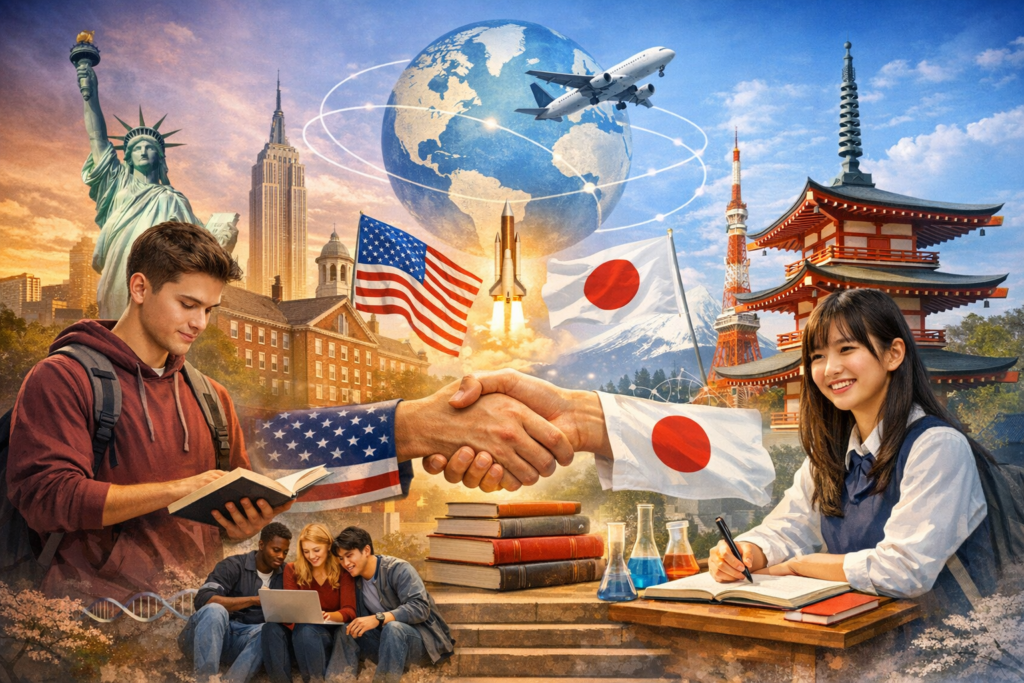
In today’s interconnected world, education is no longer limited by borders. Students increasingly seek opportunities beyond their home countries to gain world-class knowledge, international exposure, and competitive career advantages. Among the most influential academic corridors is the USA–Japan scholarly landscape—a powerful bridge between two global education giants.
The United States is known for its innovation-driven universities and research excellence, while Japan is admired for its discipline, technological advancement, and cultural depth. Together, they form a unique educational ecosystem that nurtures “rising stars”—students and researchers who aim to shape the future through global learning experiences.
This article explores how educational dreams are fulfilled within the USA–Japan academic relationship, the opportunities available, challenges faced, and why this collaboration is becoming increasingly important in the modern world.
The USA–Japan Academic Connection: A Global Power Partnership
The educational relationship between the United States and Japan is built on decades of academic exchange, research collaboration, and cultural understanding. Both countries recognize the importance of knowledge sharing in fields such as science, engineering, medicine, business, and humanities.
The United States is home to world-renowned universities like:
- Harvard University
- Massachusetts Institute of Technology
- Stanford University
Japan, on the other hand, hosts prestigious institutions such as:
- University of Tokyo
- Kyoto University
- Osaka University
These universities are not just academic institutions—they are innovation hubs where global talent converges to solve real-world problems.
Why Students Choose the USA–Japan Scholarly Path
The USA–Japan educational route is becoming increasingly popular among ambitious students due to several compelling reasons.
1. World-Class Education Systems
The United States is known for flexible and research-oriented education, while Japan offers structured, disciplined, and technology-focused learning. Combining both gives students a well-rounded academic experience.
2. Cutting-Edge Research Opportunities
Both countries invest heavily in research and development. Fields such as artificial intelligence, robotics, biotechnology, and environmental science benefit greatly from USA–Japan collaboration.
3. Cultural Exchange and Global Exposure
Students experience two distinct yet complementary cultures:
- The innovation-driven, diverse culture of the United States
- The disciplined, tradition-rich society of Japan
This exposure helps students develop adaptability and global awareness.
4. Career Advancement
Graduates from USA–Japan academic programs are highly valued in global job markets. Employers appreciate their international experience, language skills, and cross-cultural understanding.
Scholarship Opportunities for International Students
Financial support plays a key role in enabling students to pursue education abroad. Both countries offer several scholarships to attract global talent.
USA Scholarships
In the United States, students can apply for:
- Fulbright Program
- University-based merit scholarships
- Research assistantships and fellowships
These programs support students in undergraduate, graduate, and doctoral studies.
Japan Scholarships
Japan also offers generous financial aid, including:
- MEXT (Ministry of Education, Culture, Sports, Science and Technology) Scholarship
- JASSO scholarships
- University-specific funding programs
These scholarships often cover tuition fees, living expenses, and travel costs.
Academic Fields Driving USA–Japan Collaboration
Several fields of study are central to the USA–Japan educational partnership.
1. Technology and Engineering
Japan is a leader in robotics and manufacturing, while the USA dominates software innovation and AI development. Together, they push technological boundaries.
2. Medicine and Healthcare
Joint research in medical science has led to breakthroughs in disease treatment, biotechnology, and public health systems.
3. Environmental Science
Both countries collaborate on climate change research, sustainable energy, and environmental protection technologies.
4. Business and Economics
International business programs benefit from the USA’s entrepreneurial culture and Japan’s efficient management systems.
The Role of Universities in Shaping Global Scholars
Universities play a critical role in developing future leaders. Institutions in both countries focus on:
- Research-based learning
- Industry partnerships
- International student exchange programs
- Innovation labs and incubators
For example, students at Massachusetts Institute of Technology often collaborate with Japanese institutions like University of Tokyo on advanced robotics and AI projects.
These partnerships allow students to gain hands-on experience and contribute to real-world innovations.
Cultural Exchange: A Key Element of Learning
Education in the USA–Japan landscape is not only about academics; it is also about cultural understanding.
Students learn:
- Japanese discipline, respect, and teamwork
- American creativity, leadership, and innovation
This combination builds globally competent individuals who can work effectively in diverse environments.
Cultural exchange programs, language courses, and student exchange initiatives strengthen this bond further.
Challenges Faced by International Students
While the USA–Japan academic pathway offers great opportunities, it also comes with challenges.
1. Language Barriers
Japanese universities often require proficiency in Japanese, while American institutions demand strong English skills.
2. Cultural Adjustment
Adapting to different social norms, education styles, and lifestyles can be difficult initially.
3. Financial Pressure
Even with scholarships, living expenses in major cities can be high.
4. Academic Pressure
Both countries have rigorous academic standards that require strong discipline and time management.
Despite these challenges, students who persist often achieve significant personal and professional growth.
The Role of Technology in Modern Education
Technology has transformed the USA–Japan educational relationship. Online learning platforms, virtual classrooms, and digital research tools have made cross-border education easier than ever.
Students can now:
- Attend joint lectures online
- Participate in international research projects remotely
- Access global libraries and databases
- Collaborate in real-time with peers across continents
This digital transformation has made education more inclusive and accessible.
Success Stories: Rising Stars of Global Education
Many students who pursue USA–Japan academic paths go on to become global leaders in their fields.
They contribute to:
- Technological innovations
- Scientific discoveries
- International business leadership
- Academic research publications
These individuals represent the “rising stars” who bridge two powerful educational systems and bring global solutions to complex problems.
The Future of USA–Japan Educational Collaboration
The future of this academic partnership looks promising. With increasing globalization, both countries are expanding their collaboration in:
- Artificial intelligence and machine learning
- Space exploration and aerospace engineering
- Climate change solutions
- Healthcare innovation
Universities like Stanford University and Kyoto University are expected to play a leading role in shaping the next generation of global research.
How Students Can Prepare for This Journey
Students aspiring to study in the USA–Japan academic landscape should focus on:
1. Academic Excellence
Strong grades and research experience improve admission chances.
2. Language Skills
Learning English and Japanese enhances communication and adaptability.
3. Research Experience
Participation in projects, internships, and publications is highly valuable.
4. Cultural Readiness
Understanding both cultures helps in smoother adaptation.
Conclusion
The USA–Japan scholarly landscape represents a powerful fusion of innovation, discipline, and global collaboration. It is a pathway where ambitious students become “rising stars,” shaping the future of science, technology, and society.
Through world-class universities like Harvard University, University of Tokyo, and Osaka University, students gain access to unparalleled opportunities that prepare them for global leadership.
Despite challenges, the rewards of this educational journey are immense—personal growth, international exposure, and career success. As the world becomes more connected, the USA–Japan academic partnership will continue to inspire generations of learners to pursue excellence beyond borders.
In the end, this scholarly landscape is not just about education—it is about building a brighter, more innovative, and more connected global future.
Leave a Reply