Introduction: The Meaning of Princeton
In the world of elite higher education, few institutions hold as much prestige and intellectual influence as Princeton University. Located in Princeton, this historic Ivy League university has built a global reputation for academic excellence, groundbreaking research, and a strong commitment to undergraduate education.
Founded in 1746, Princeton is not just a university—it is a tradition of thought leadership, innovation, and scholarly distinction. From producing Nobel Prize winners to shaping global leaders, Princeton continues to play a defining role in education and society. This article explores its history, academic structure, student life, research excellence, and global impact.
A Brief History of Princeton University
The story of Princeton University began in 1746, originally established as the College of New Jersey. It was later renamed Princeton University in 1896.
Early Foundations
The university was founded during a time when higher education in America was still developing. Its early mission focused on:
- Training clergy and leaders
- Promoting classical education
- Strengthening intellectual development
Growth into an Ivy League Institution
Over time, Princeton evolved into one of the most respected universities in the world and became a member of the prestigious Ivy League alongside institutions such as Harvard University.
Today, Princeton is recognized globally for its academic rigor and selective admissions process.
Academic Excellence: A Culture of Deep Learning
One of the defining characteristics of Princeton University is its strong emphasis on undergraduate education.
Small Class Sizes
Unlike many large universities, Princeton maintains:
- Low student-to-faculty ratio
- Personalized instruction
- Close academic mentorship
This allows students to engage deeply with their professors.
Concentrations Instead of Majors
Princeton refers to academic majors as “concentrations,” emphasizing intellectual focus and depth.
Popular fields include:
- Computer Science
- Economics
- Political Science
- Engineering
- Mathematics
The Residential College System
Student life at Princeton University is shaped by its residential college system.
What Are Residential Colleges?
First-year and sophomore students live in residential colleges that provide:
- Housing
- Dining facilities
- Academic advising
- Social events
Benefits of the System
This system creates:
- Strong community bonds
- Intellectual engagement outside classrooms
- Smooth transition into university life
Campus Life in Princeton, New Jersey
Life in Princeton offers a balance of academic intensity and peaceful surroundings.
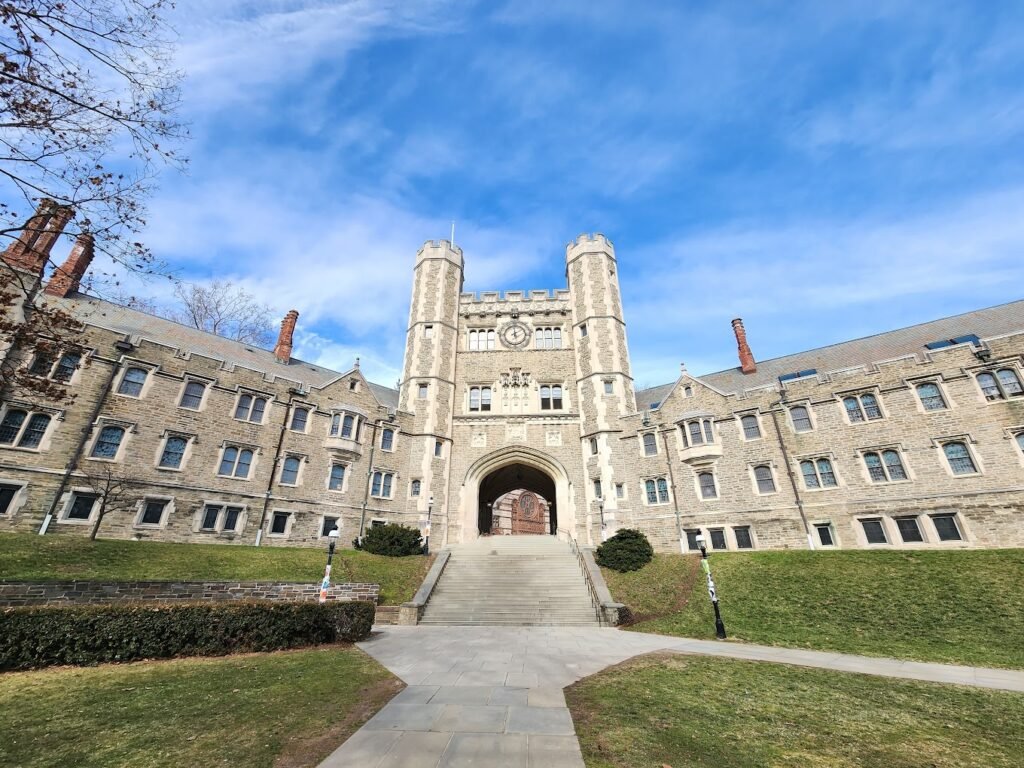
A Beautiful Campus
The campus features:
- Gothic-style architecture
- Green open spaces
- Historic buildings
It is often considered one of the most beautiful campuses in the world.
Student Activities
Students participate in a wide range of activities:
- Cultural organizations
- Performing arts groups
- Sports teams
- Volunteer programs
Eating Clubs
A unique aspect of Princeton life is its “eating clubs,” which serve as social and dining communities for upper-year students.
Admission Process: Highly Selective Excellence
Gaining admission to Princeton University is extremely competitive, with acceptance rates typically below 5%.
Application Requirements
Applicants must demonstrate:
- Exceptional academic performance
- Strong standardized test scores (where applicable)
- Leadership qualities
- Extracurricular involvement
- Personal essays
Holistic Review Process
Princeton evaluates students based on:
- Intellectual curiosity
- Character and values
- Potential for impact
This ensures a diverse and talented student body.
Financial Aid: Making Princeton Accessible
Despite its elite status, Princeton University is committed to affordability.
Need-Based Aid System
Princeton offers one of the most generous financial aid programs in the world.
- No-loan policy for many students
- Grants instead of loans
- Full coverage for eligible families
Commitment to Accessibility
Students from all financial backgrounds are encouraged to apply, ensuring that talent—not wealth—determines admission.
Academic Research and Innovation
World-Class Research Facilities
Princeton is a leader in research across multiple disciplines, including:
- Physics
- Public policy
- Artificial intelligence
- Environmental science
Institute for Advanced Study Collaboration
Princeton has strong connections with the nearby Institute for Advanced Study, where scholars like Albert Einstein once worked.
Breakthrough Contributions
Princeton researchers have contributed to:
- Quantum physics
- Climate modeling
- Mathematical theories
Global Influence and Alumni Impact
Graduates of Princeton University go on to become leaders in various fields.
Notable Alumni Fields
- Politics and government
- Business and finance
- Academia and research
- Technology and innovation
Leadership and Public Service
Many alumni serve in global leadership roles, influencing policy and decision-making worldwide.
Princeton and Ivy League Identity
As a member of the Ivy League, Princeton shares prestige with universities like Harvard University.
What Sets Princeton Apart?
- Strong undergraduate focus
- Emphasis on independent research
- Close-knit academic community
Technology and Modern Innovation
Computer Science Excellence
Princeton has one of the top computer science programs globally, producing graduates who work at companies such as:
- Microsoft
Entrepreneurship and Startups
Students and faculty often engage in startup culture, contributing to innovation in technology and business.
Challenges and Academic Pressure
While prestigious, Princeton is also known for its academic intensity.
High Expectations
Students face:
- Heavy workload
- Competitive academic environment
- Rigorous evaluation standards
Mental Health Awareness
The university has increased support systems to help students manage stress and maintain well-being.
Life After Princeton: Career Opportunities
Employment Outcomes
Graduates of Princeton University are highly sought after by top employers.
Graduate Studies
Many students continue their education at elite institutions or pursue advanced research degrees.
Global Career Paths
Alumni work in:
- International organizations
- Leading corporations
- Academic institutions
Cultural and Intellectual Environment
A Thinker’s University
Princeton is known for encouraging:
- Deep intellectual inquiry
- Independent thinking
- Academic exploration
Diversity and Inclusion
The university continues to expand diversity initiatives, welcoming students from around the world.
Future of Princeton University
Expanding Access
Efforts are being made to increase accessibility for students from all backgrounds.
Digital Learning
Princeton is integrating online learning tools and hybrid education models.
Research Priorities
Future focus areas include:
- Climate change solutions
- Artificial intelligence ethics
- Global health challenges
Conclusion: A Tradition of Excellence and Impact
Princeton University stands as a symbol of intellectual excellence, innovation, and leadership. From its historic roots in Princeton to its global influence today, Princeton continues to shape the world through education and research.
Its commitment to small-scale learning, world-class faculty, and groundbreaking research makes it one of the most respected universities on the planet. While admission is highly competitive, the opportunities it offers are transformative and long-lasting.
In essence, Princeton is more than a university—it is a lifelong journey of discovery, intellectual growth, and global impact.
Leave a Reply